

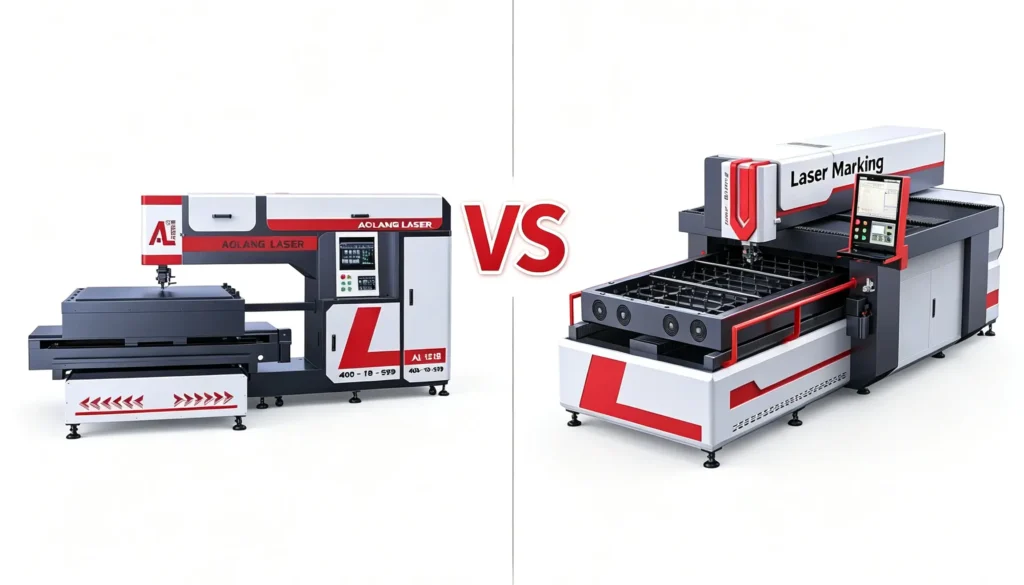
If you run a die-making workshop or packaging print shop, picking the right laser die board cutter directly affects your throughput, floor layout and long-term ROI. The AL-CT600-1218 and AL-GT600-1325 are two of the most widely used CO₂ laser die board cutters in the die-making sector.
Many buyers struggle with this choice: 1218 vs 1325 laser die board cutting machine – which one fits my die shop?
This side-by-side comparison covers working size, production performance, space needs, pricing, and ideal use cases for both machines.
What Do AL-CT600-1218 & AL-GT600-1325 Model Names Mean?
These model numbers refer to the machine’s working cutting dimensions (width × length):
- 1218 Laser Die Board Cutter: Working area 1200 mm × 1800 mm (4ft × 6ft)
- 1325 Laser Die Board Cutter: Working area 1300 mm × 2500 mm (4ft × 8ft)
Both are CO₂ laser die board cutters, offered with 400W / 600W / 800W laser tube options. They cut plywood die boards in thicknesses of 6, 15, 18, 20 and 22 mm, and create 2pt, 3pt, 4pt kerf slots for steel rule dies. Both models accept DXF/DWG files, feature auto focus, and maintain stable cutting accuracy of ±0.05 mm for packaging die manufacturing. But the 1325 includes an optional marking function and uses a front-suction & rear-blowing fume extraction design for superior fume removal.
Side-by-Side Comparison Table
| Item | 1218 Laser Die Board Cutting Machine | 1325 Laser Die Board Cutting Machine |
| Working Cutting Area | 1200 × 1800 mm (4×6 ft) | 1300 × 2500 mm (4×8 ft) |
| Optical Structure | Fixed beam path; worktable moves along X & Y axes | Constant beam path; laser tube moves on X axis; worktable moves on Y axis |
| Floor Space Needed | Larger footprint | Compact footprint |
| Production Capacity | Medium batches; small & mid-size dies | High-volume, large-format die boards; full plywood sheet cutting |
| Smoke Extraction | Standard fume extraction | Front-suction & rear-blowing fume system, superior fume removal |
| Extra Function | — | Optional marking function |
| Packing & Transport | Packed in 2 separate plywood crates; more complex on-site assembly | Single plywood crate; simple loading, easy shipping & installation |
AL-CT600-1218 Laser Die Board Cutting Machine: Pros & Cons
Advantages
- Fixed beam path design: The laser assembly remains stationary while the worktable travels forward, backward, left and right during cutting. This delivers stable optical performance for regular small and medium die projects.
- Great for small-to-medium die work: Most standard carton, label and small-box die boards fit within its 1200×1800 mm cutting bed.
Limitations
- Larger footprint: The moving worktable needs clearance around the machine, so it takes up more workshop floor space.
- Two-crate packaging: The machine ships in two separate packages. On-site assembly takes longer and is more complex.
- Cannot process full 4×8 ft plywood sheets. If you regularly produce large-format die boards, drawings must be split and cut in multiple runs, costing time and lowering productivity.
Who should buy the 1218 laser die board cutter?
- Die shops mostly producing small & medium die boards
- Workshops with ample available floor space
- Teams accustomed to fixed beam path machine setups
AL-GT600-1325 Laser Die Board Cutting Machine: Pros & Cons
Advantages
- Constant beam path design: The laser tube travels left and right, while the worktable only moves forward and backward. This layout saves floor space, delivering a compact footprint even with its large cutting size.
- Full 4×8 ft plywood sheet processing: Load full standard plywood sheets directly without splitting, to significantly boost daily output.
- Front-suction & rear-blowing fume system: Excellent fume extraction keeps the cutting zone clean during long continuous runs.
- Optional marking function: The same machine can be fitted with a laser marking system.
- Single integrated plywood crate: Easy container loading, simple delivery, and fast, hassle-free on-site installation.
- Comparable pricing to the 1218 model, for better overall value.
Limitations
- While the machine footprint is compact, you still need to measure your workshop doorway before delivery to ensure smooth entry.
Who should buy the 1325 laser die board cutter?
- Die shops regularly manufacturing large corrugated box dies and full-size plywood sheets
- Workshops with limited floor space but needing a large cutting format
- Teams prioritizing simple installation and reliable fume extraction
- Businesses planning for fast order growth and long-term production expansion
How To Make Your Final Decision
Ask yourself these three simple questions before you choose:
- What die board sizes do your customers order most often? If most dies are shorter than 1.8 m, the 1218 will suffice. If you regularly cut dies longer than 1.8 m or full 4×8 ft plywood sheets, go with the 1325.
- How much usable workshop space do you have? If floor space is limited, the 1325 is the better fit. The 1218 requires extra clearance for its moving worktable.
- What do you need for installation and fume extraction? Pick the 1325 for simple setup, front-suction rear-blowing fume removal and optional marking. If you prefer fixed beam path equipment and have ample floor space, the 1218 is a solid option.
There is no universal “better” model. The ideal laser die board cutter depends on your typical job sizes, available workshop space, and business growth roadmap.
The 1218 laser die board cutter features a fixed beam path, has a larger footprint, and ships in two plywood crates. It suits operations with ample floor space focused on small and medium die jobs.
The 1325 laser die board cutter uses a constant beam path design. It has a compact footprint, supports full-sheet cutting, and comes with front-suction rear-blowing fume extraction plus optional marking. It ships in a single plywood crate for simple transport and installation, at a price comparable to the 1218.
If you are still unsure which model fits you, send us your typical die board sizes and monthly production volume. We will recommend the best CO₂ laser die board cutting solution for your shop.
FAQ
Q1: What thickness plywood can this laser die cutter cut?
It can cut up to 18mm plywood, which is the most common thickness for steel rule die making.
Q2: How long is the service life of the 600W CO₂ laser tube?
Under normal working conditions, the laser tube can work for thousands of hours. We provide spare parts support globally.
Q3: Can the machine work with my existing die design files?
Yes. It supports common vector formats like AI, DXF, PLT. You can directly import your die cutting drawings.
Q4: Do you provide overseas installation and training?
We offer online operation training. On-site service can also be arranged.
Q5: What after-sales support do you have?
1-year warranty for main machine, lifetime technical consultation and spare parts supply.
Get Your Quote
Send us your die board size and cutting requirements, we will reply with a tailored quotation within 24 hours.
Email: sales@aolanglasers.com
Website: https://aolanglasers.com